Dubai's roads are made for driving fast and far, but they're not exactly gentle on expensive paintwork. Flying stones on Sheikh Zayed Road, sand kicked up on highway stretches, the odd bit of debris you never see coming — even a Porsche 911, a Corvette, or a Range Rover that's babied every single day can end up with chips and scratches before long.
Paint Protection Film helps cut down on that damage significantly. But there's a question every owner eventually has to answer: do you go all-in with full body PPF, or does a front-end package cover what you actually need? Honestly, it depends — on the car, how often you drive it, what kind of roads you're mostly on, and how much you're willing to put into it. At Oscar Legacy Auto Services, we evaluate every tier so you invest where protection actually matters.
1. What's Actually in a Front End PPF Package?
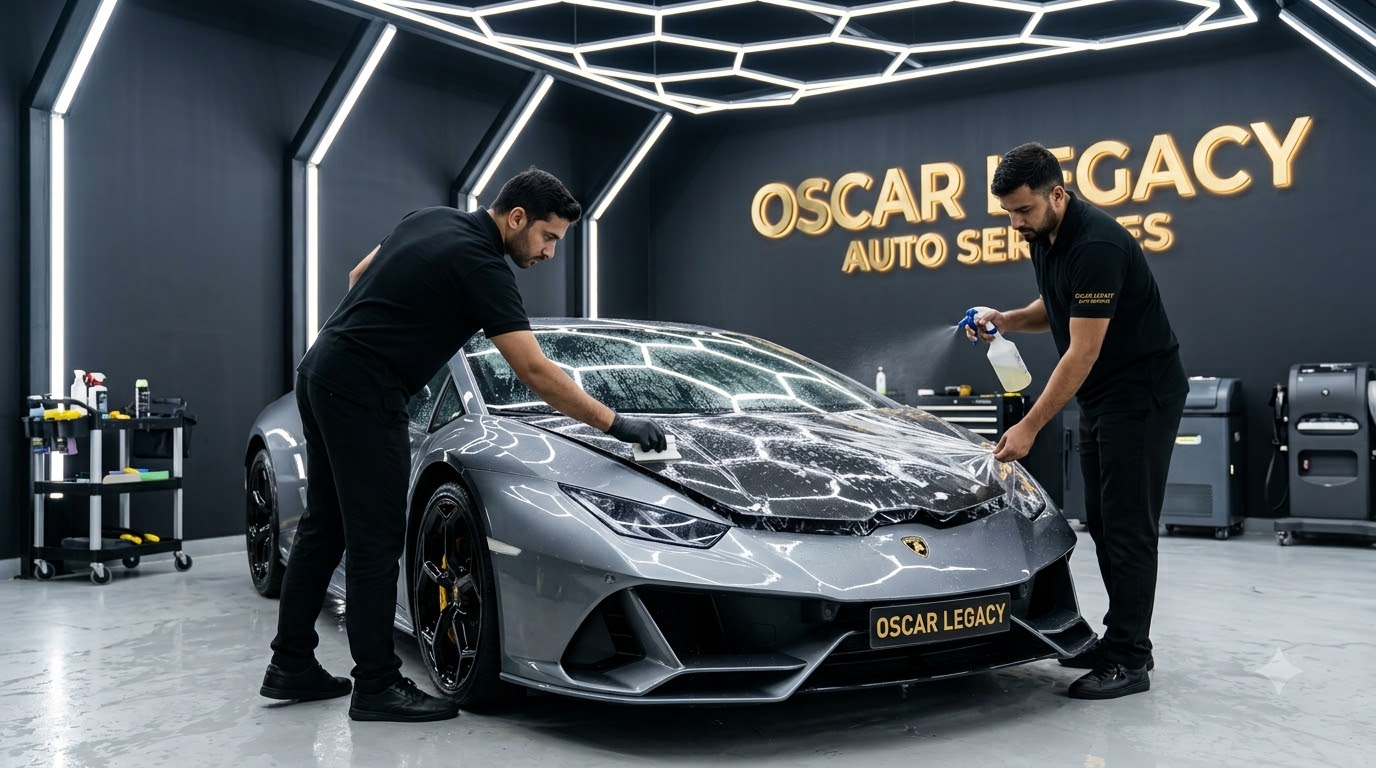
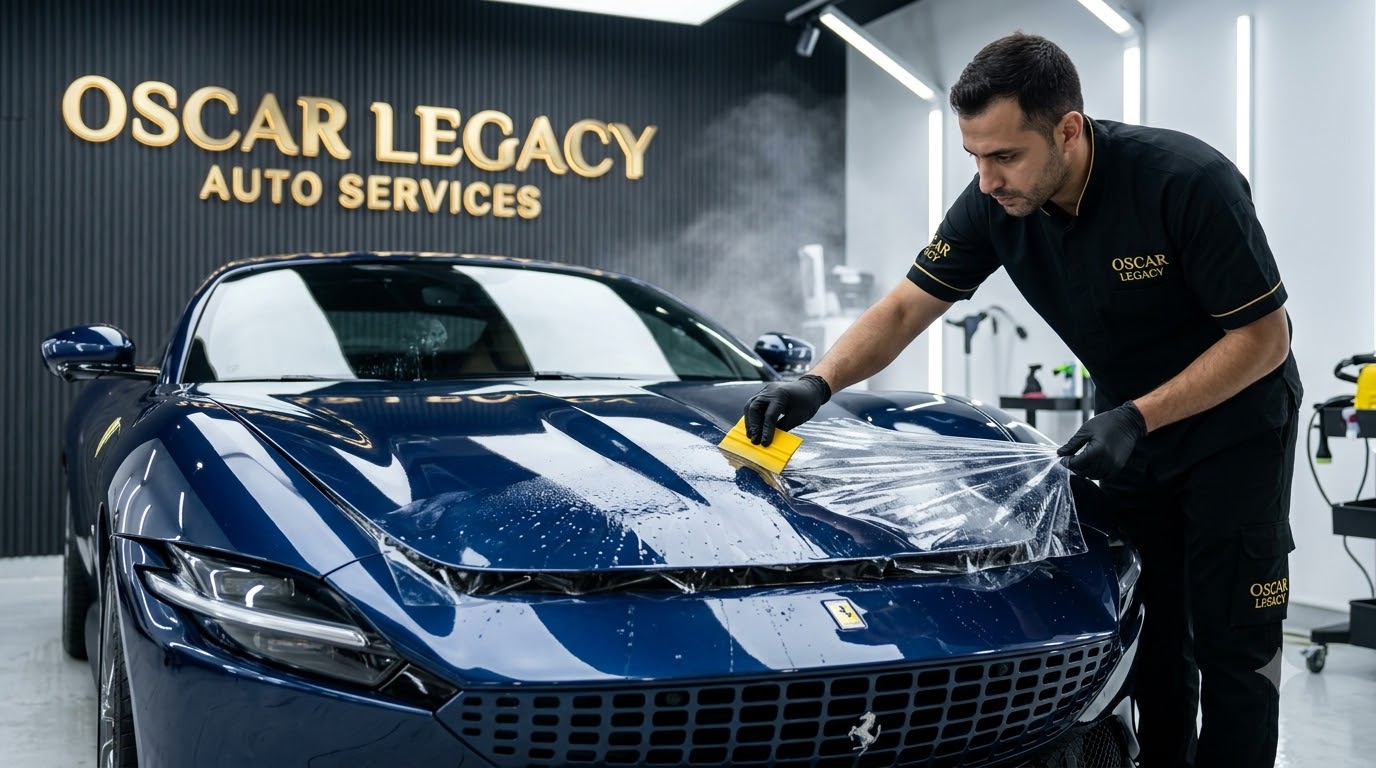
A front-end package focuses on the parts of the car that take the brunt of road debris. A proper full-front setup usually covers:
- Front bumper: First in line for stones, insects, and anything flying up off the road.
- Full bonnet: Not just the leading edge, the whole panel seamlessly wrapped.
- Front fenders: The panels flanking the bonnet and front wheels.
- Headlights: Where the film is compatible, it helps cut down on surface pitting to the expensive lenses.
- Wing mirrors: Protects the aerodynamic mirror caps from minor scuffs and highway debris.
If you're mostly commuting around Dubai in a luxury car, this combination tends to hit the sweet spot between solid protection and reasonable cost. One thing worth flagging — a full-front package isn't the same as a cheaper partial-front option, which might only cover part of the bonnet and fenders. That can leave visible film edges and strips of exposed paint, which honestly looks worse than no film at all in some cases.
2. What Does a Track Pack Add?
Think of the track pack as the front-end package's more ambitious sibling — built for sports cars, performance driving, and anyone racking up serious highway miles. On top of full front coverage, you'll typically get:
- A-pillars: Shielding the front windshield pillars from glancing pebble strikes.
- The leading edge of the roof: Protecting the high-impact forward roof strip.
- Side skirts and rocker panels: Defending against sandblast kicked up by the front tires.
- Lower panels: Areas vulnerable to coarse debris flung backwards at speed.
- Select splash zones around the wheel arches: Rear quarter leading flare sections.
These extra areas genuinely matter on low-riding cars like the Porsche 911 or Chevrolet Corvette, where debris doesn't just hit the front — it gets thrown up directly into the lower bodywork too.
3. Does a Track Pack Really Stop 90% of Highway Damage?
You've probably seen this number thrown around in marketing — track pack PPF stopping "up to 90%" of common highway impacts. There's some logic behind it: the bumper, bonnet, fenders, and lower panels really do take most of the hits from road debris, so covering them addresses a lot of what causes stone chips in the first place.
That said, treat the 90% figure as a rough estimate, not a lab-tested guarantee. It shifts depending on your car's shape, the roads you're on, how fast you're driving, and exactly which panels got covered. It's more accurate to think of a track pack as protection concentrated in the high-impact zones, rather than a fixed percentage you can bank on.
4. What Full Body PPF Actually Covers
Full body PPF goes further — essentially every painted exterior panel on the car. Beyond what a front-end package covers, you're also getting the doors, roof, rear quarters, boot lid, and rear bumper wrapped.
This makes a lot of sense if you want even, all-around protection against the small stuff — light scratches, parking lot scrapes, shopping cart scuffs, and general wear that builds up over years of ownership. For cars with pricey factory paint, unusual colors, or satin finishes, the extra cost often feels justified.
5. Does Full Body PPF Make the Car Scratch-Proof?
Not quite, no. Good-quality PPF does come with a self-healing top layer that can make light scratches and swirl marks fade away with a bit of warmth, and it acts as a sacrificial layer against plenty of minor abrasions and stone hits. But it's not armor. Deep scratches, hard impacts, collisions, or serious abrasions can still cut through or tear the film. The real value of full body coverage is broader protection across the whole car — not some kind of invincibility.
6. Coverage and Price, Side by Side (2026 Dubai Market)
Here is how the three tiers compare across panel protection and investment:
| Feature / Panel | Full Front | Track Pack | Full Body |
|---|---|---|---|
| Front bumper | Yes | Yes | Yes |
| Full bonnet | Yes | Yes | Yes |
| Front fenders | Yes | Yes | Yes |
| Wing mirrors | Yes | Yes | Yes |
| Headlights | Usually | Usually | Confirm |
| A-pillars | Optional | Usually | Yes |
| Rocker panels | No | Usually | Yes |
| Doors and rear quarters | No | No | Yes |
| Roof and rear bumper | No | Limited (Roof edge) | Yes |
| Pricing / Quotation | Custom Quote | Custom Quote | Custom Quote |
Actual investment shifts depending on vehicle contours, panel complexity, and chosen film brand tier. Contact Oscar Legacy specialists for a tailored quotation based on your exact vehicle requirements.
Request a Bespoke PPF Estimate
PPF installation scope depends on individual coverage preferences, vehicle body contours, and chosen film brand tier. Contact Oscar Legacy specialists for a tailored quotation.
Inquire via WhatsApp